Prostrations
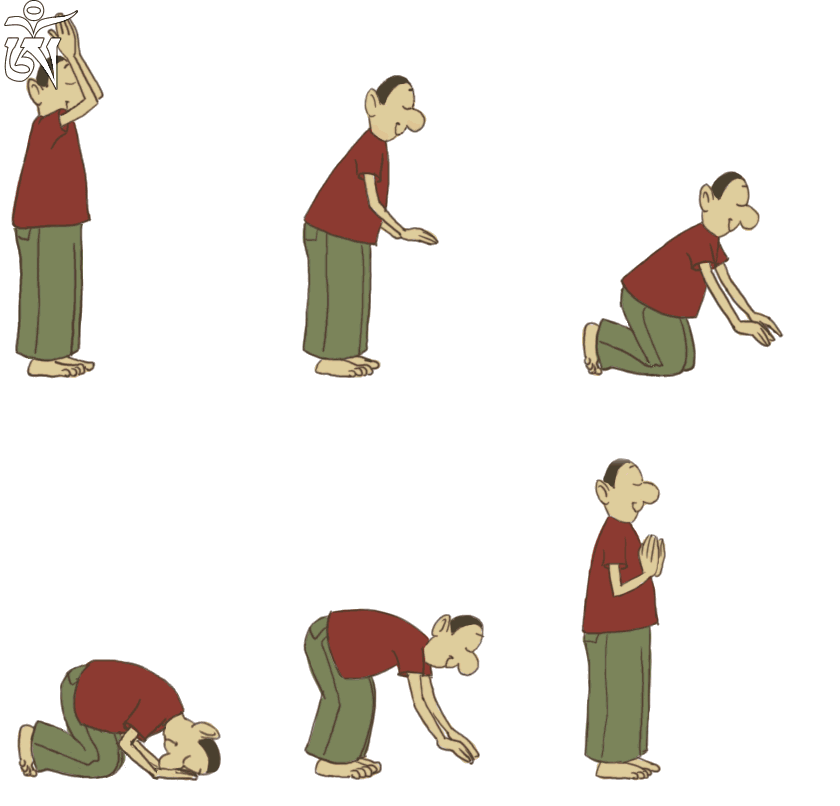
We bring our hands, joined together, to the top of the head, requesting the blessing of our body and its activities. We visualize a white OM. Once the request is made, white light comes from the Buddhas and Bodhisattvas, entering the crown chakra and blessing our body.
Then our hands go to our throat, where we visualize a red AH. We request the blessing of our speech. Red light comes and enters our throat chakra, blessing our speech.
Our hands now go to our heart, where we visualize a blue HUNG. “Please, all Buddhas and Bodhisattvas, grant supreme blessing to my mind.” Blue light comes from the heart of all Buddhas and Bodhisattvas, entering our heart, lifting all misconceptions and clarifying our mind.
Now we kneel down, and our forehead touches the ground. Five points are in contact with the floor: two knees, two hands, and the forehead. At that moment, we feel that the five poisons — anger, attachment, ignorance, pride, and jealousy — are leaving our mind.
Through the blessing obtained, and the positive work against pride and attachment, the five poisons are transformed into the five corresponding wisdoms (the wisdom of the universal law, the wisdom of the mirror, the wisdom of equality, the wisdom of distinction and discernment, and the wisdom of accomplishing works). Having abandoned the five poisons, we stand up swiftly and begin again.
We prostrate in this way three times, for the Three Jewels. When we stand up the third time, we bring our hands again to the three places, requesting the blessing of the Guru.
If you engage in a practice such as the “Purification to the 35 Buddhas” — which requires 108 prostrations — or if you are performing the prostration retreat (100,000 prostrations), then after some time your body will be tired. It is said that this moment can be used to engage in a practice like Shine, to calm the mind.
Above is described the “short” prostration, mainly performed in front of a teacher, before a teaching. In the “purification practice to the 35 Buddhas”, or during retreat, it is the long version that is performed.
Reasons and Benefits
It is often asked why we should prostrate. Many people feel quite uneasy whenever they have to bow down, or even worse, to kneel down.
It has nothing to do with worshipping a person, or any kind of God-like being. When you prostrate, the first thing it works on a lot is pride. We have built such a sense of superiority, or self-sufficiency, that it is difficult to develop the correct kind of respect and devotion toward our holy teachers and the Buddhas. Over many lifetimes, because of pride, we have accumulated so many negativities. Understanding this, prostration takes part in the purification of those negativities, and helps transform our mind.
Prostration is also connected with our understanding of the Three Jewels as our true objects of refuge, the supreme embodiment of all qualities. To bow down is the least sign of respect we can show.
As the purification proceeds, we become more aware of the importance of taking refuge, of relying on a root Guru, and of giving up ourselves for the sake of others — for here is the supreme motivation: to engage with joy in all the practices, with the intention to soon be able to help as many other sentient beings as possible.
From a physical point of view, prostration helps bring a better balance to our energies, smoothing the energy channels, releasing blockages, and thereby making our mind more supple.
When you prostrate in front of a Lama, you should perceive this person as a Buddha, possessing all perfect qualities. You are then bowing down to the Buddha.
When prostration is done as a practice, you visualize the Refuge Tree in front of you, with your Guru at the centre, the Tantric Buddhas and all other Buddhas and Bodhisattvas beneath, and further beneath, the Dharma protectors and the protectors of the four directions. Above are the Lamas of the lineage, with Guru Vajradhara at the top. It is in front of this noble assembly that you prostrate.
Copyright 2026 by Buddhist Congregation Dharmaling
May all beings benefit